Monday, July 25, 2011

Pittock Mansion Pruning

I went to volunteer at the gardens at Pittock Mansion this morning with the intention of doing battle with the re-emerging Vinca, but it turned out to be pruning day.

We had a nice array of weaponry at our disposal to address the DDDDD's of pruning: Dead, Dying, Diseased, Damaged, Disoriented.

The tools were pretty new to me, but it didn't take long to get the hang of them. Pole mounted tools sure beat having to use ladders to get close to everything. Though they also had some nice 3-point orchard ladders for getting up high enough to clean up the crowns. A chain saw on a stick is a beautiful thing.

After working on three of the cherry trees, I spend a little bit of time starting to clean up a pretty scraggly little fellow....

Saturday, June 11, 2011

Plant Propagation -- Followup -- Labor of Division

In week 6 of the PCC Plant Propagation class we did some work dividing plants. Recently I took a couple followup pictures.

Then:


Now:


Then:


Now:


Gardening at 1860s Kitchen Garden

I volunteered for the first time at the 1860's Kitchen Garden at Champoeg State Park. It has a lovely rustic arbor covered with hops.
The garden has several prepared beds. Most of the bed is typically in one crop with a little patch at the end need the path planted in something different.

I liked the use of cloches (glass bell jar) to give some plants a head start.

There were some terrific trellises made from apple tree trimmings. Some had the buds bloom after they were planted.
Here is a nice arrangement for beans to climb on...
I worked on making a large trellis that we took to calling trellizilla that will obscure the modern electrical box once the plants grow up.

A view of the garden with the threshing barn beyond.
I liked the look of their compost bins as well.

Portland adventure

Sharon had a meeting downtown so we decided to make an adventure of it and walked to the Max and took the Green Line to Pioneer Square. On the way we saw some navy ships docked for Fleet Week.


I hopped off early to check out the offices of Timber Press which publishes a number of books I have enjoyed and many more that I want. I asked them if I could get a discount if I bought one of each. Turns out you can get 10% off if you buy $200 or more. That would be easy do. I probably found 40 books that would be nice to have. Then I remembered the reading stack I am actively trying to work through. They are coming out with a book on Free-Range Chicken Gardens that looks really cool.

When I finally made it to Pioneer Square to meet up with Sharon there was a cool display of flowers in the form of a World Map.


We enjoyed the view as we shared a Honkin' Huge Burritto.


Tuesday, May 24, 2011

PCC Spring Tree Care Bracing Practice

Our Spring Tree Care class ventured outside to take care of a Juniperus scopulorum 'Tolleson's Green Weeping'. This was a tree we looked at last quarter in the Winter Plant ID course. The first step is to form a plan.
More than a simple case of included bark, this tree actually had two branches that have grown right against each other. We decided on two bracing rods, one above and one below the crotch.
Once we had our plan of attack we drilled the first hole with a very long 3/8" bit to accept a 3/8" rod.
Juan Carlos hacked the rod down to size.
We decided after quite a discussion to remove one small branch that was crossing and twining around the low branch shown on the left. Then we repeated the process for the upper rod, which was a little trickier to line up, but went fine. To me the tree still looks out of balance and would do better without that lower left limb all together.
Here is a look at our handiwork.
Once we were done, we took a look at some cabling done on the Medlar (Mespilus germanica). It looks very in flower.

Monday, May 23, 2011

Tree Problem 10: Huge Oak

Site: Street tree on S side of my street. (NE Portland)

Biases:
+ Truly impressive tree providing an enormous amount of shade.
- Some of the large pruned branches look a little awkward with long residual stumps.

Tree Characteristics
A truly enormous Oak (Quecus rubra(?)) an over-mature tree with a single trunk DBH 60"! Live crown ratio is around 50%.


Tree Health
New foliage seems vigorous. Certainly puts out enough nuts to keep the squirrels busy.

Site Conditions
Street tree with good southern exposure. Level ground, no direct irrigation except in adjacent lawn.


Targets
Houses, cars, power lines.


Tree Defects
Constrained root space by sidewalk (some lifting) and street (roots spilling over curb)Some exposed roots near base.


Hazard Rating
Part most likely to fail: Branch failure. Low failure potential on Huge parts with significant targets for a hazard rating of 1+4+4 = 9.


Hazard Abatement
Corrective pruning: Prune for branch end weight. Inspect for any potential problems. Rationale: This is such an amazing tree that it is definitely worth aggressive preventative maintenance to head off any problems. The geometry of the tree and mass of the branches does not look favorable for cabling.

Other Recommendations
Climb this tree!

Tree Problem 9: Rotten Maple

Site: Street tree on S side of my street. (NE Portland)


Biases:
+ Big tree providing much appreciated shade late in the day in the summer.
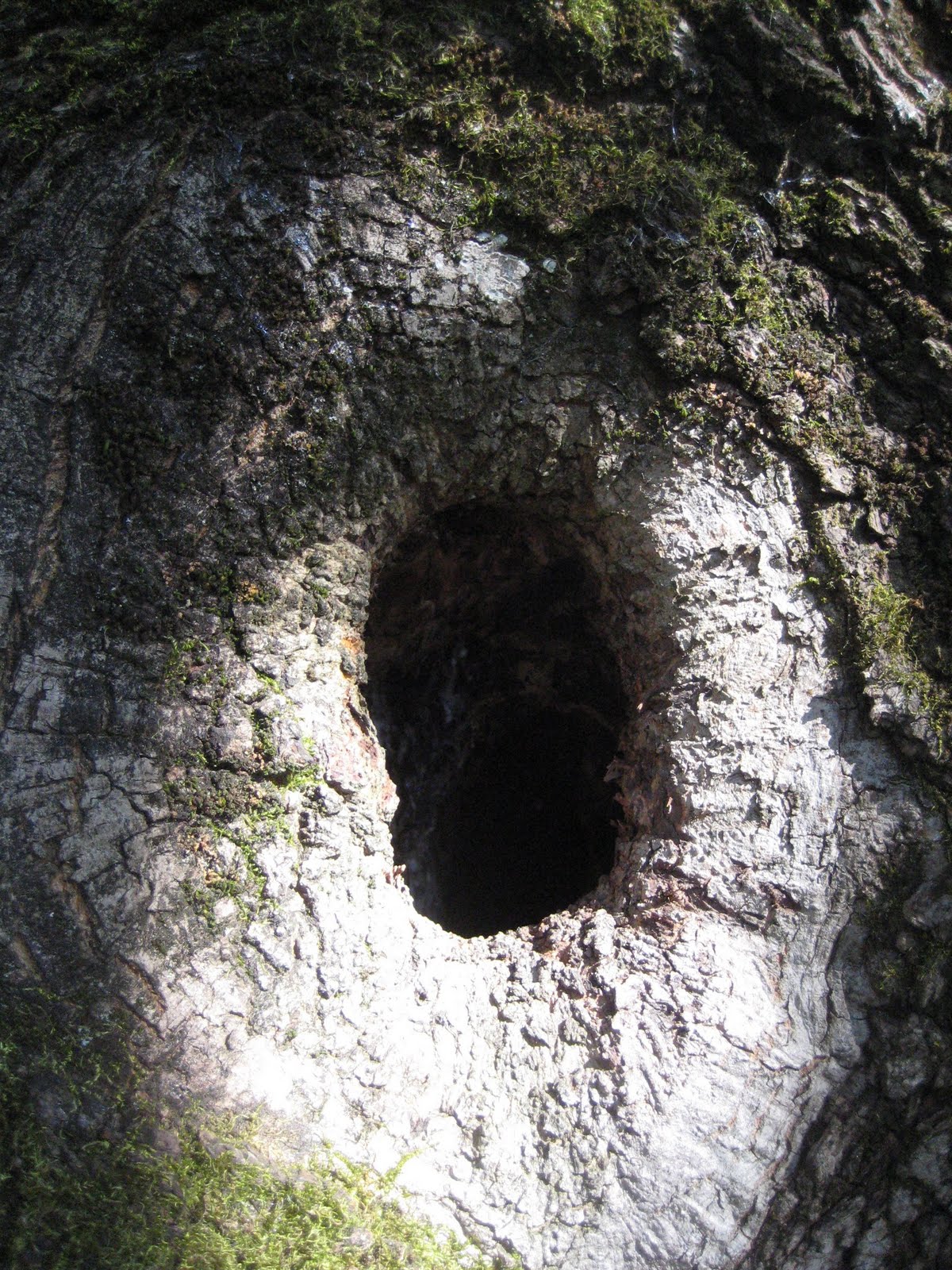
- Has enough decay that you can see daylight through the trunk!

Tree Characteristics
This is some sort of Maple, maybe another Norway (Acer sp.) a young-mature tree with a single trunk DBH 28". Live crown ratio is around 50%.


Tree Health
New foliage looks healthy. Many pockets of decay. Two of the old pruning cuts have decayed together so you could pass something into one whole and out the other!

Site Conditions
Street tree with good southern exposure. Level ground, no direct irrigation except in adjacent lawn.


Targets
House, cars, power lines.

Tree Defects
Rotted out core in several places. Constrained root space by sidewalk. Some sidewalk lifting.


Hazard Rating
Part most likely to fail: branch failure. Severe failure potential on large parts with significant targets for a hazard rating of 4+3+4 = 11.


Hazard Abatement
Get inspected (I think this has happened, in fact). Rationale: Some trees can continue to grow even when the core of the trunk has rotted out, need to figure out if this is such a case or not.

Other Recommendations
If it has enough strength to continue to grow the key is to ensure that growth exceeds the rate of decay. Pruning for branch weight would be a good idea.